Early detection of high-altitude hypoxic brain injury
People who climb too fast or too high risk acute altitude
sickness, which can lead to life-threatening hypoxic brain injury. By
using in vivo electrochemistry, researchers
demonstrated that characteristic changes occur in the oxygen content of
various brain regions before injury. As a team reports in the journal Angewandte
Chemie, the risk of brain damage could be predicted days in
advance—perhaps a new approach for detecting high-altitude hypoxic
injury.
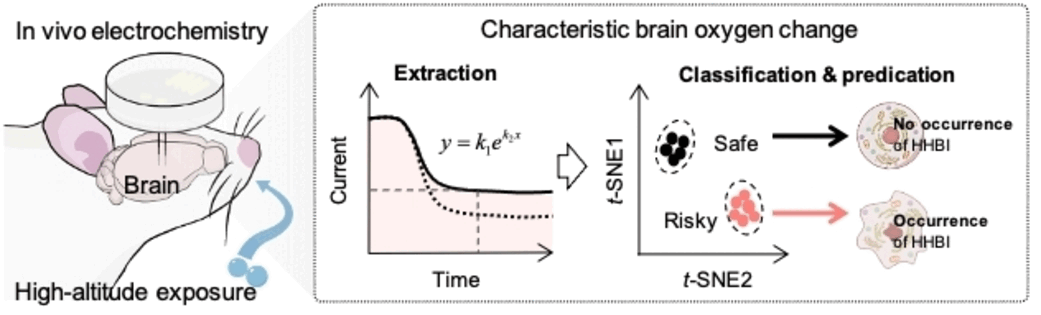
© Wiley-VCH, re-use with credit to 'Angewandte Chemie' and a link to the original article.
Because of the low air pressure and low partial pressure of
oxygen at high altitude, the brain does not have an adequate
oxygen
supply (hypoxia). This not only happens when skiing or mountain
climbing
if you get to 2500 m too fast, but people who live in regions
above 3000 m in South America or Asia, for example, can also be affected
despite
their acclimation (chronic altitude sickness). The mild form of
acute
altitude sickness begins about four to six hours after climbing,
with a
headache. If the climb is not interrupted, additional problems may
develop, such as dizziness, nausea, and a racing heart. At this
point,
descent to lower altitude or treatment in a (portable) pressure
chamber
and administration of oxygen are critical to prevent hypoxia and
life-threatening high-altitude hypoxic brain injury (HHBI).
Most current methods for the early detection of HHBI leave
a lot to be desired with regard to speed and precision. A team led by
Lin Zhou and Bin Su at Zhejiang University (China) has proposed an approach for a novel strategy based on changes
in the oxygen content of regions of the brain over time.
By using fine biocompatible electrodes, the team examined
the relationship between the oxygen content in different areas of mouse
brains and the degree of HHBI under simulated exposure to high altitude
(3000 to 7500 m) in a low-pressure chamber. Hypoxia in the brain
immediately triggered the transport of oxygen from other organs to the
brain. Within about two hours, the brain additionally redistributed the
oxygen: brain regions with higher tolerance for hypoxia received less
oxygen to support supply to more important areas.
The electrochemical measurements showed that at a simulated altitude of 3000 m, the oxygen
content of the primary somatosensory cortex (responsible for the sense
of touch) sank more rapidly than that of the hippocampus (responsible
for memory). In both areas, it sank more rapidly than the reduction of
blood oxygen saturation. These measurements correlate with memory and
sensory tests. Under normal pressure, the animals recovered completely.
In contrast, after three days at simulated 7500 m, the oxygen content
of both areas sank to roughly similarly low values. The mice suffered
from severe HHBI, including cell death. At intermediate heights,
individual animals reacted differently. Based on the currents measured
within the first one or two hours of low-pressure simulation, it was
possible to predict whether and in which area a mouse would suffer HHBI
three days later.
Based on the characteristics of the changes in brain oxygen
level, it was possible to predict the risk of HHBI several days in
advance. The team hopes to use these insights as the basis for
possible early detection of impending HHBI.
(3306 characters)
About the Author
Dr Bin Su is the Qiushi Distinguished Professor at Chemistry Department of
Zhejiang University and the director of Institute of Analytical
Chemistry. His main specialty is electrochemiluminescence,
electrochemical in vitro diagnosis and in vivo analysis.
Copy
free of charge—we would appreciate a transcript/link of your article.
The original articles that our press releases are based on can be found
in our online pressroom.