Highly efficient recycling process for NCM lithium-ion batteries
A simple, highly efficient, inexpensive, and
environmentally friendly process could provide a viable pathway for the
sustainable recycling of depleted lithium-ion batteries (LIBs): No
chemicals beyond citric acid need to be added to leach out and separate
over 99 % of the lithium, nickel, cobalt, and manganese metals contained
in NCM batteries. The resulting recycled material can be directly
converted into NCM electrodes, reports a research team in the journal Angewandte
Chemie.
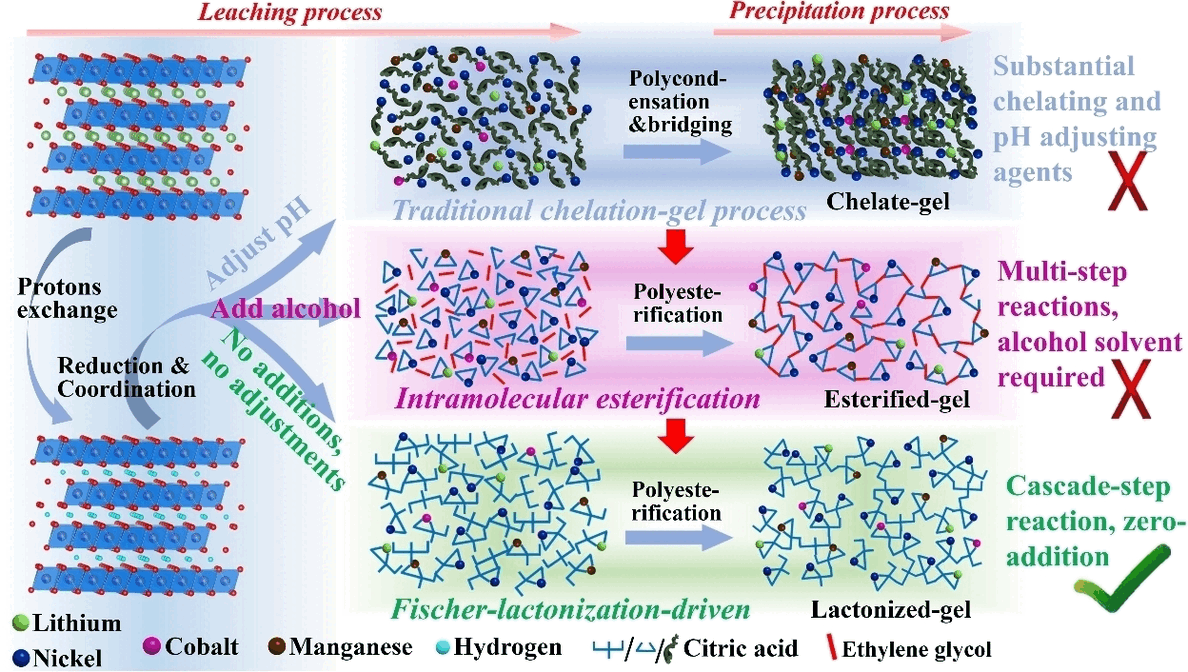
© Wiley-VCH, re-use with credit to 'Angewandte Chemie' and a link to the original article.
From smartphones to electric vehicles, lithium-ion
batteries are everywhere in our daily lives. They are also an important
component of our transition to renewable energy, as they are used to
store excess solar and wind energy and send it back into the power grid
on demand. The downside is that their limited lifespan results in vast
numbers of spent LIBs that contain dangerous heavy metals and other
hazardous materials. In addition, metal resources are being depleted.
Most recycling processes suffer from high energy usage,
high emissions, and limited or low-quality recovered material. Or they
require very large amounts of chemicals, are complicated and expensive,
and produce toxic gases and run-off. Leaching with biocompatible acids
like citric acid is one alternative to these processes. However,
conventional processes (chelation-gel process) require a significant
excess of the acid, and the pH value must constantly be adjusted with
ammonia—complicated and not very environmentally friendly.
A team at China University of Mining and Technology
(Beijing), Fuzhou University, Beijing University of Chemical Technology,
and Tsinghua University, Shenzhen (China) led by Guangmin Zhou and
Ruiping Liu has now developed a novel citric-acid-based method for the
leeching, separation, and reclamation of metals from NCM cathodes. NCM
is a mixed oxide containing nickel, cobalt, and manganese in a lamellar
structure. Lithium ions are enclosed between the layers.
The trick to their method: Instead of leeching with an
excess of citric acid like conventional methods, they use a relatively
small amount. Because of this, only two of the three acid groups in the
citric acid dissociate. The released protons break up the lithium-oxygen
bonds, releasing lithium ions from the NCM into the solution. Bonds
between the other metal ions and the oxygen ions are also broken. Nickel,
cobalt, and manganese enter the solution, where they are bound into stable
complexes by the citric acid anions. The third acid group of the citric
acid then reacts with the hydroxyl group on the same molecule. A ring
closure occurs in an intramolecular esterification (Fischer
lactonization) reaction. This facilitates the reaction of the
intermediates with each other to make a polyester, which gels into solid
particles that can easily be separated out. Energy consumption and CO2
emissions are significantly less than in conventional hydrometallurgical
recycling processes.
The gel can subsequently be heated to burn off the organic
fragment. This results in a new NCM lamellar framework with included
lithium ions, which can be used as a high-quality electrode material.
(3235 characters)
About the Author
Dr Ruiping Liu is Professor at the School of Chemical and
Environmental Engineering at China University of Mining and Technology
(Beijing). His major research mainly focused on the synthesis of
functional materials, and their applications in batteries and catalysts.
Copy free of charge—we would appreciate a transcript/link of your
article. The original articles that our press releases are based on can
be found in our online pressroom.